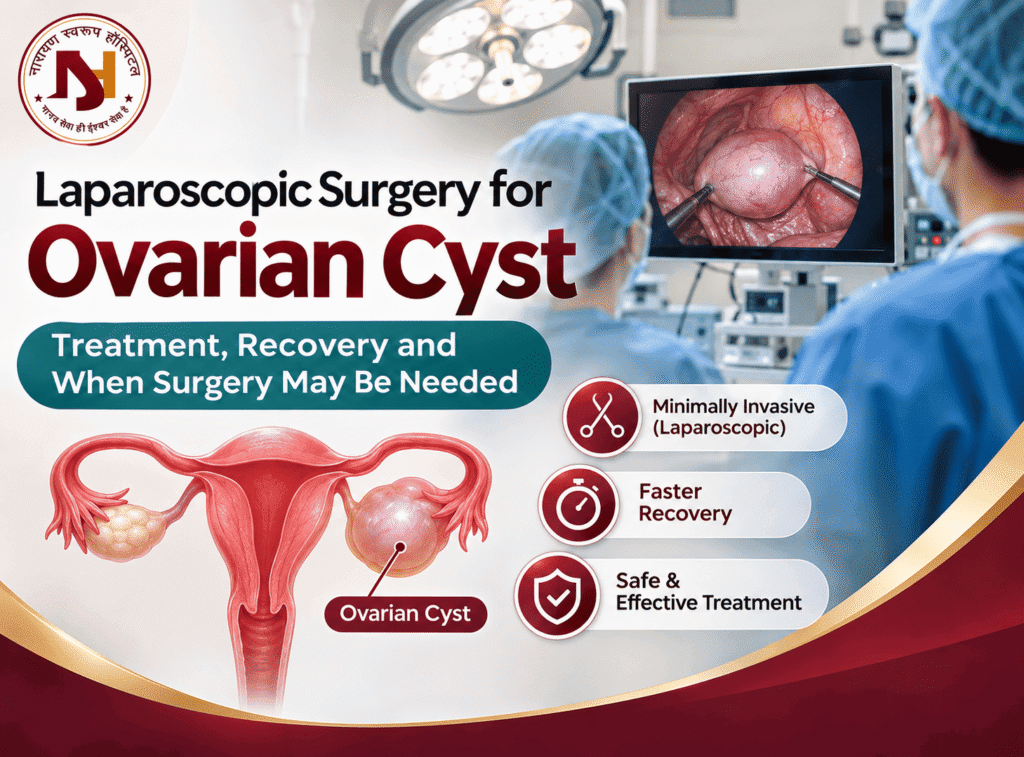

Ovarian cysts are very common amongst women and especially during their reproductive years. They may be harmless and self-limiting, but they may sometimes require treatment due to pain and other associated complications.
In the case where the cyst continues to persist, increases in size, or exhibits other disturbing symptoms, the doctor may decide to operate through laparoscopy in order to remove the ovarian cyst. This is a relatively minor surgical operation carried out through small abdominal incisions.
However, not all ovarian cysts require surgery. There are various factors that will determine how the problem will be handled.
These include the size of the cyst, its features, whether the woman has other symptoms, her age, and reproductive intentions.
What Is an Ovarian Cyst?
Ovarian cyst is a fluid-filled or partially solid sac that occurs in or on the surface of an ovary.
Cysts develop spontaneously as part of the menstrual cycle and heal spontaneously.
There are several types of cysts, which are:
- Functional cysts: Occur during ovulation and usually go away on their own.
- Dermoid cysts: Consist of tissue like hair and fat.
- Endometriomas: Develop as a result of endometriosis of the ovaries.
- Cystadenomas: Originates from ovarian tissue and contains fluid or mucus.
The majority of ovarian cysts are benign; however, there are those that need further investigation.
Common Symptoms of Ovarian Cysts
A lot of women do not have any symptoms; however, when present, they include:
- Pelvic pain or heaviness that might be on one side.
- Abdominal bloating.
- Painful sex.
- Frequent urination due to bladder pressure.
- Menstrual irregularities.
If a woman suffers from sudden sharp pain in her pelvis, especially in case of vomiting and nausea, she should visit a doctor immediately.
When Is Laparoscopic Surgery for Ovarian Cyst Needed?
Uncomplicated cysts that are thought to possibly heal spontaneously are usually managed by observation.
Laparoscopic surgery to remove an ovarian cyst may be indicated if:
- The cyst remains present or grows larger.
- Pelvic pain is persistent and interferes with activities.
- Imaging findings are complicated or abnormal.
- There is suspicion of possible ovarian torsion caused by the cyst.
- An endometrioma is causing symptoms.
- Further investigation is required to make a diagnosis.
This management strategy would also depend on whether menopause has occurred and whether there is a suspicion of cancer.
Notably, if imaging indicates the likelihood of ovarian cancer, specialized management will be required. Normal removal of an ovarian cyst using laparoscopy will not be sufficient.
How Is Laparoscopic Ovarian Cyst Surgery Performed?
Laparoscopy is an innovative method of surgery which enables the doctor to inspect the pelvic organs by making several small abdominal incisions.
1. Preoperative Examination
Prior to surgery, the patient’s complaints, medical history and ultrasound results are reviewed by a gynaecologist.
In addition, the following tests might be conducted:
- Ultrasound of the pelvis or transvaginal ultrasound.
- Blood tests, if needed.
- Pregnancy test if indicated.
- MRI or other imaging methods in selected cases.
Anaesthesia issues, risks and potential complications as well as fertility aspects are also discussed.
2. The Surgical Procedure
The procedure is usually conducted under general anaesthesia.
Several cuts are made on the abdomen and a laparoscope, which is a thin instrument with a camera, is inserted into the abdominal cavity.
The carbon dioxide gas is injected to create space to inspect the pelvic organs.
With the help of special instruments, the doctor examines the cyst and removes it.
3. Cyst Removal and Ovarian Preservation
In some cases, the doctor conducts a cystectomy, removing the cyst while preserving the rest of the ovary.
Sometimes removal of the damaged ovary might be required due to the suspicion or any other clinical indications.
The removed tissue is usually sent for examination.
Potential Benefits and Risks of Laparoscopic Surgery
There are several advantages associated with laparoscopy compared to open surgery.
These include:
- Smaller cuts into the abdomen.
- Reduced pain after surgery in certain situations.
- Less time spent in the hospital.
- Quick resumption of normal activities.
- A decreased risk of wound complications in some patients.
But laparoscopic surgery is not without its complications.
Some of these include:
Bleeding,
Infections,
Harm done to other organs,
Blood clots and complications due to anesthesia.
Sometimes conversion to an open procedure becomes necessary.
No method of surgery can ensure complication-free surgery or fertility.
Recovery After Gynaecological Surgery
Knowledge about recovery following gynaecological surgery can help patients be better prepared for their recovery period.
Postoperatively, some women recover and get discharged the same day or the next day, following simple laparoscopic cyst removal.
There might be mild discomfort, fatigue, and pain in the shoulders due to remaining gases.
Important Points in Patient’s Recovery
They should:
- Take medications as prescribed.
- Keep surgical incisions clean and dry.
- Gently walk to facilitate circulation.
- Not do any strenuous physical activity and lifting weights until clearance from a doctor.
- Have adequate hydration and healthy nutrition.
Attend follow-up visits.
Most patients recover enough to go back to daily activities within 1-2 weeks.
However, recovery differs from patient to patient and depends on the operation performed.
Related Conditions: Fibroids and Endometriosis
It is not necessarily an ovarian cyst causing pelvic pain and menstrual difficulties. There may be other causes such as fibroids and endometriosis causing similar signs.
Treatment for Fibroids
Fibroids are benign tumors that grow within or in the vicinity of the uterus.
Common symptoms associated with fibroids are profuse bleeding, abdominal pressure, and a frequent need to urinate.
Treatment methods used for fibroids are as follows:
- Monitoring for small asymptomatic fibroids.
- Medications to treat bleeding or pain caused by fibroids.
- Myomectomy for removal of fibroids without affecting the uterus.
- Uterine artery embolization in selected cases.
- Hysterectomy when appropriate.
Management will depend on the size of the fibroid, its location, symptoms and plans for having children in the future.
Endometriosis Symptoms and Treatment
Endometriosis happens when uterine tissue-like grows outside the uterus.
Symptoms of endometriosis include painful menstruation, chronic pelvic pain, painful sex and difficulty getting pregnant.
Knowledge about endometriosis symptoms and treatment is important since endometriomas located in the ovaries might need to be surgically treated.
When Should You Consult a Doctor?
Women should consider gynecological examination in case pelvic signs persist, worsen or affect their daily activities.
Consultation with a health practitioner is indicated in the following cases:
- Pelvic pain that persists or recurs.
- Unusual swelling in the abdomen.
- Excessive or abnormal vaginal bleeding.
- Pain during sex.
- Problems with conception, together with pelvic signs.
- A cyst of the ovary discovered through ultrasound.
Emergency consultation should be sought in case of sudden and severe pelvic pain, fainting, severe dizziness or pelvic pain, combined with continuous vomiting.
Frequently Asked Questions
1. Are ovarian cysts capable of disappearing without surgery?
Many functional ovarian cysts tend to resolve spontaneously in several menstrual periods. Ultrasound follow-up is often prescribed for observation.
2. Is it possible to get pregnant after undergoing ovarian cyst surgery laparoscopically?
It is possible to conceive after the operation if healthy ovarian tissue is left after the procedure.
3. How long does ovarian cyst surgery laparoscopically last?
The duration of the surgery depends on various factors such as size, localization of the cyst, complexity of the surgery and others. The surgeon can give you an approximate answer based on your situation.
4. Will ovarian cysts recur after their removal?
Ovarian cysts are likely to recur especially if the woman suffers from endometriosis.
5. Is laparoscopic surgery appropriate for any ovarian cyst?
Laparoscopy is not always the best method of ovarian cyst treatment, especially in case of large or complicated ovarian masses.
Conclusion
Ovarian cysts are frequent conditions and most of the time, they do not need surgery. But sometimes, due to the persistence of the symptoms, imaging results or other related factors, a patient is recommended to undergo surgery.
It is also possible that laparoscopic surgery might be considered in some cases for the excision of ovarian cysts which might be better in terms of smaller scars and recovery period than conventional open surgery.
Knowledge about the procedure, risk factors and post-operative care is essential for patients when making decisions about the treatment.