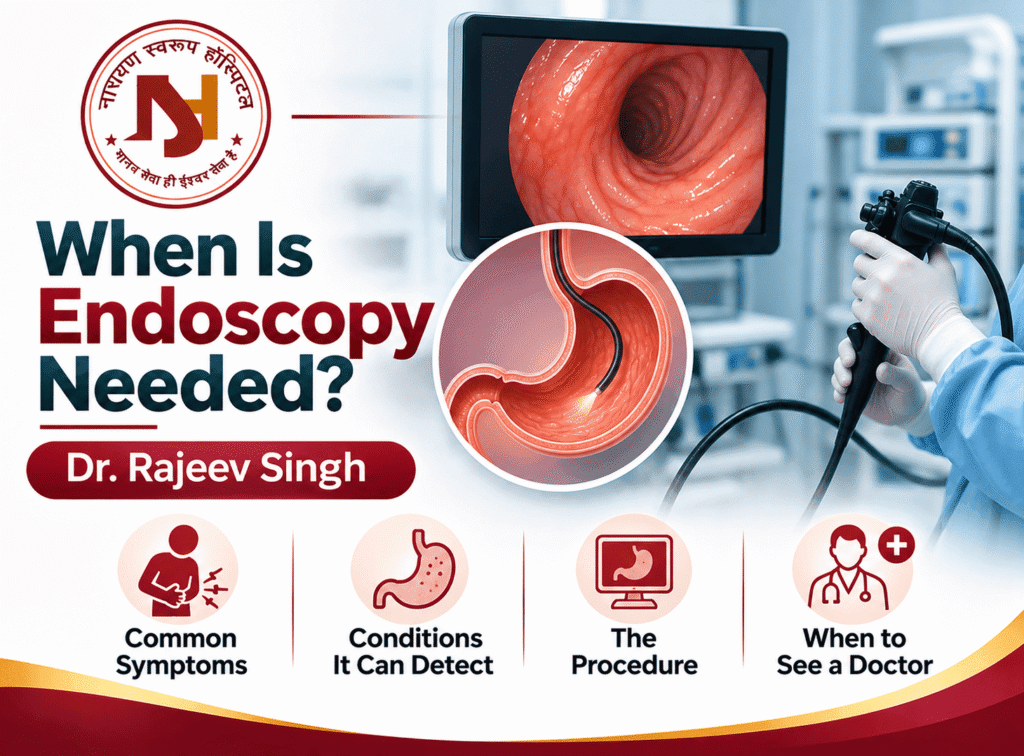

When Is Endoscopy Needed? | Dr. Rajeev Singh
Frequent acidity, upper abdominal discomfort or difficulty swallowing can make people worry that something is wrong with their stomach. Others assume that any persistent digestive symptom automatically requires a camera test. Neither assumption is reliable. Sometimes symptoms improve with an examination and appropriate treatment; at other times, a closer look inside the digestive tract helps identify a serious problem.
So when is endoscopy needed? The answer depends on the symptoms, their duration, warning signs, age, medical history and what earlier tests have shown. This article explains why a doctor might advise an upper gastrointestinal endoscopy and what patients should understand before agreeing to it.
What Does Upper GI Endoscopy Examine?
Upper GI endoscopy, also called gastroscopy or oesophagogastroduodenoscopy, uses a flexible tube with a camera to examine the food pipe (oesophagus), stomach and first part of the small intestine. The instrument enters through the mouth, usually after local throat anaesthetic and sometimes sedation.
It is not the same test as colonoscopy, which examines the large bowel. Endoscopy may allow a clinician to examine tissue directly, take a small sample called a biopsy, or perform certain treatments. A biopsy does not automatically mean cancer is suspected; tissue samples can help investigate several conditions.
Which Symptoms Might Lead to an Endoscopy Recommendation?
A doctor may consider an upper GI endoscopy when symptoms suggest a problem that cannot be explained adequately by history, examination or initial treatment. Possible reasons include:
- Persistent or unexplained difficulty swallowing food or liquids.
- Ongoing upper abdominal pain or vomiting despite assessment.
- Reflux symptoms that do not improve with appropriate treatment.
- Suspected bleeding in the upper digestive tract.
- Unexplained anaemia when gastrointestinal blood loss is a concern.
- A need to examine a suspected ulcer or another abnormal finding.
Not every person with heartburn or indigestion needs an endoscopy. The urgency and choice of test depend on the whole clinical picture. Symptoms affecting swallowing deserve timely assessment, especially when they are getting worse.
What Are the Warning Signs That Need Prompt Care?
Vomiting blood, passing black tar-like stool, fainting with suspected bleeding or having severe chest or abdominal pain requires urgent medical evaluation. Do not wait for a routine outpatient endoscopy appointment in these situations.
Progressively worsening swallowing difficulty, unexplained weight loss, repeated vomiting and persistent anaemia are also important to discuss with a clinician promptly. They do not establish a particular diagnosis but may alter how quickly testing is arranged.
How Is Endoscopy Different From an Ultrasound or CT Scan?
Each investigation answers a different question. Ultrasound can assess certain abdominal organs, while CT provides detailed cross-sectional images. Upper GI endoscopy directly shows the internal lining of the oesophagus, stomach and duodenum and can obtain biopsies when indicated.
For example, an ultrasound may be useful when gallbladder disease is suspected, but it does not replace a gastroscopy for examining an ulcer in the stomach lining. Equally, an endoscopy cannot answer every question about the liver, pancreas or bowel. Doctors choose tests based on the suspected cause rather than treating one procedure as universally better.
What Happens Before an Endoscopy Procedure?
The healthcare team will explain why the test is recommended and ask about allergies, previous reactions to sedation and medicines such as blood thinners or diabetes treatment. Tell the team about pregnancy, heart or lung conditions, and any difficulty with swallowing.
You will receive specific fasting instructions. Do not assume that another hospital’s instructions apply to you, because timing and medication advice may differ. If sedation is planned, you may need an accompanying adult and should not drive afterwards for the period advised by your clinical team.
A good consent discussion should cover the expected benefit, alternatives, possible discomfort and risks. Ask whether biopsies are likely and when results will be available.
What Happens During and After the Test?
During an upper GI endoscopy, a clinician gently passes the scope through the mouth to view the digestive tract. A mouth guard is often used. Patients receiving sedation are monitored. Many diagnostic procedures are completed relatively quickly, although the exact time depends on what is required.
Afterwards, mild throat soreness or bloating can occur. The team will explain when drinking and eating are safe, particularly if throat anaesthetic was used. Initial findings may be available the same day, while biopsy reports usually take longer.
Most people recover without a serious problem. Rare complications include bleeding, a reaction to sedation or a tear in the digestive tract. Seek urgent help after the procedure for breathing problems, worsening severe chest or abdominal pain, fever, vomiting blood or black stools.
Should You Ask for Endoscopy Without a Consultation?
A test is most useful when there is a clear question it is intended to answer. Bringing a symptom diary can make consultation more productive. Record whether pain relates to eating, how often vomiting occurs, whether weight has changed and which medicines you have taken.
Questions worth asking are: What condition are we investigating? Could another test be more suitable? Will the result change my treatment? Is sedation planned? What happens if the result is normal? These questions support informed decision-making without unnecessarily demanding or refusing a procedure.
Endoscopy Consultation in Prayagraj
The hospital’s official profile identifies Dr. Rajeev Singh as an endoscopist and laparoscopic surgeon. If you are searching for an endoscopy specialist in Prayagraj, discuss your symptoms first and confirm which investigation and specialist are appropriate. The hospital can advise on appointment and service availability. Emergency bleeding symptoms require immediate medical assessment instead of an elective booking.
For broader information about surgical versus minimally invasive procedures, see General Surgery vs Laparoscopic Surgery. That article addresses surgical approaches; this guide focuses on the decision to investigate upper digestive symptoms.
Frequently Asked Questions
Is endoscopy required for ordinary acidity?
Usually not automatically. A clinician considers severity, persistence, warning signs and response to initial care.
Does an endoscopy always involve a biopsy?
No. Tissue samples are taken only when the clinician considers them useful for diagnosis.
Is upper GI endoscopy the same as colonoscopy?
No. Upper GI endoscopy examines the oesophagus, stomach and duodenum, while colonoscopy examines the large bowel.
Conclusion
Endoscopy is recommended for specific clinical reasons, not simply because stomach discomfort is common. Knowing what symptoms matter, how the test works and which warning signs require urgent care helps patients make informed decisions with their healthcare team.
Our Recent Blogs
Hospital Location: Narayan Swaroop Hospital on Google Maps
Medical References: NIDDK: Upper GI Endoscopy
Medical disclaimer: Educational information, not an individual recommendation for testing. This draft requires qualified clinical review before publication.


