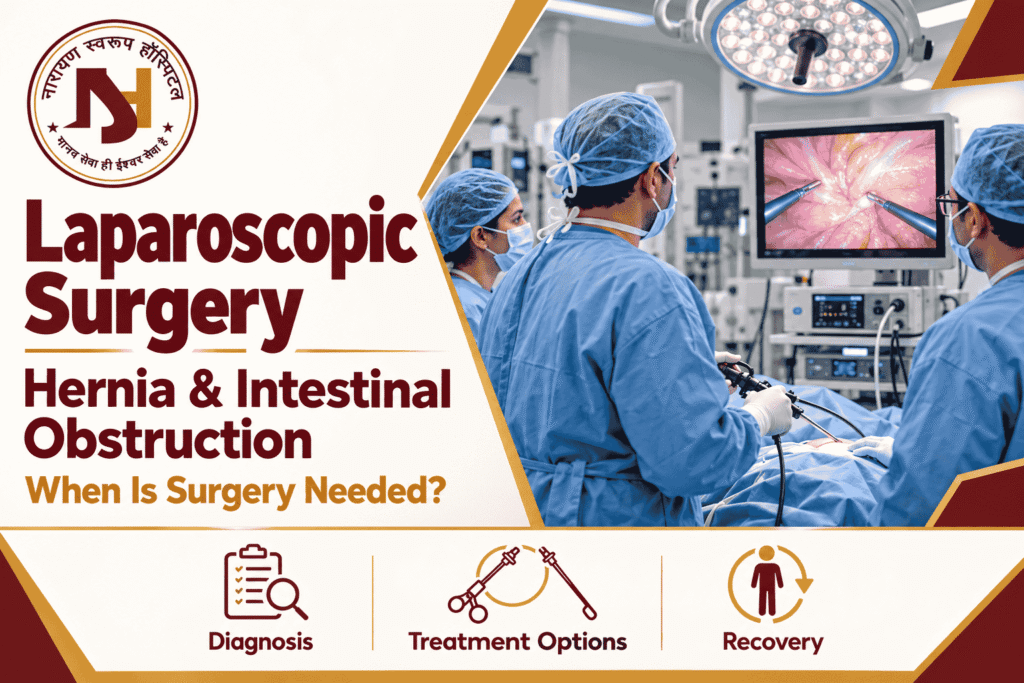

Symptoms like abdominal pain, swelling, and problems related to digestion might indicate some medical conditions like a hernia or intestinal obstruction, which might be severe at times. Some conditions can be treated by merely watching the condition or taking some medicines but others may require surgical treatment.
If you are looking for an advanced laparoscopic surgeon in Prayagraj, understanding when hernia or intestinal obstruction may require surgery can help you prepare for your consultation.
Laparoscopy, which is also termed as minimally invasive surgery, involves making some cuts and using specific tools for treatment of some abdominal diseases. But all patients cannot undergo this surgery.
In this article, we will talk about symptoms, diagnosis, treatment and other factors related to hernia and intestinal obstruction along with some questions that patients need to ask Dr. Rajeev Singh.
Understanding Hernia and Intestinal Obstruction
Even though both conditions have their impact on the abdomen, they are different and need specific attention from medical professionals.
Definition of Hernia
A hernia is defined as an instance when one of the internal organs or tissues protrudes through the muscle or other body structures where there is weakness.
The most common forms are:
- Inguinal Hernia: Found in the groin area.
- Umbilical Hernia: Located near the navel.
- Incisional Hernia: Formed close to the previous surgical incisions.
- Femoral Hernia: Can be found in the upper thigh area.
Some of the factors causing hernia may be muscle weakness, excess abdominal pressure, pregnancy, constant coughing or straining.
Symptoms include visible lump, pain during lifting objects and feeling of pressure in the affected area.
What Is Intestinal Obstruction?
An intestinal obstruction arises in situations where food, fluid, and air have difficulty passing through the large or small intestines.
Some of the causes of an intestinal obstruction include:
- Adhesion s from past surgeries on the abdomen.
- Hernia which leads to trapping of a section of the bowel.
- Cancers and tumors.
- The twisting of the bowel also known as voluptuous.
- Narrowing caused by some inflammatory disorders.
Symptoms could include severe stomach pains, vomiting, bloating, and inability to expel stool or gases.
When Is Laparoscopic Hernia Surgery Needed?
Not all hernias require urgent surgical intervention. It is determined by the size, position, symptoms, and the risk of complications.
Laparoscopic hernia surgery is recommended in case:
- the hernia provokes severe pain or discomfort;
- the swelling grows gradually in size;
- it becomes hard for a person to do their daily routines;
- The hernia usually occurs because of the physical load;
- surgical treatment is indicated based on the clinical examination.
Sometimes, people with asymptomatic hernias need to observe the development of their condition instead of surgery.
On the contrary, a painful and irreducible hernia with vomiting or changes in skin color is an alarming symptom.
How Is Laparoscopic Hernia Repair Performed?
In laparoscopic hernia repair surgery, the surgeon creates small cuts in the abdomen and inserts the camera and instruments into the area.
The tissue is returned to its place, and the weakness is fixed. In some cases, the surgeon may use surgical mesh for reinforcement.
The surgery is usually done under general anesthesia.
When Does Intestinal Obstruction Require Surgery?
Intestinal obstruction is not always surgical. Partial intestinal obstructions can resolve with in-patient treatment and close observation.
Possible treatments could be:
- Replacement of lost fluids intravenously.
- Limitation of food and fluids orally for a period of time.
- Gastric intuition to reduce pressure and vomiting.
- Close observation of abdominal symptoms and blood work.
But in some cases, intestinal obstruction surgery would be required if the blockage does not resolve.
Warning Signs That May Require Emergency Surgery
Emergency surgery may be indicated in the presence of:
- Strangulation – poor blood flow to the intestine.
- Bowel perforation – formation of a hole within the intestine.
- Peritonitis – inflammation of the abdomen cavity.
- Complete obstruction with clinical findings.
- Increasing pain and instability in cases of bowel damage.
Laparoscopy might be an option for some patients, however, extensive bowel distension, adhesions or instability may lead to the indication for open surgery.
Bowel obstruction cannot be treated at home.
Role of an Advanced Laparoscopic Surgeon in Prayagraj
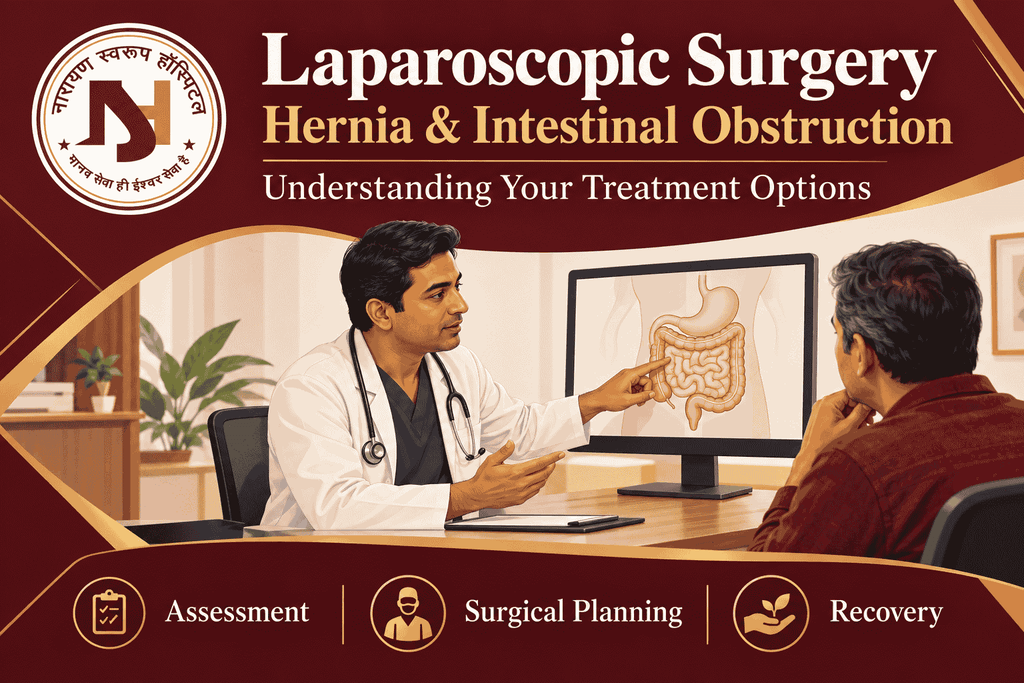
A surgeon assesses the diagnosis, symptoms, previous operations and overall health to decide whether laparoscopic or open surgery is appropriate.
The doctor makes his decision based on the analysis of the following factors:
- Symptoms, history of a patient and the results of physical examination and diagnostics.
- In diagnostic procedure may involve the following techniques:
- Ultrasound – to diagnose some abdominal and groin hernias.
- Computerised tomography – to identify and localize intestinal obstruction and associated complications.
- Blood tests – for detecting dehydration, infection and other abnormalities.
When patients meet Dr. Rajeev Singh they can discuss whether surgery is applicable in their case, what else they may choose and what risks are involved.
Final decision is based on specific clinical findings not just on patients’ preferences.
Potential Benefits and Limitations of Laparoscopic Surgery
Laparoscopic surgery can provide numerous advantages as compared to conventional open surgery, depending on patients’ selection.
These advantages include:
- Small surgical incisions and scar reduction.
- Reduction in post-surgical pain in selected cases.
- Fewer days spent in hospital for selected patients.
- Quicker recovery.
- Less likelihood of complications related to the surgical wound.
At the same time, minimal surgery poses certain risks, such as bleeding, infection, damage to adjacent organs, and anaesthesia complications.
At times, it is necessary for laparoscopy surgery to be performed using an open surgery approach.
The most appropriate choice is based on the condition of the patient and the results of surgery.
Recovery After Laparoscopic Surgery
Recovery differs based on whether there has been surgery for a simple hernia or an intestinal obstruction.
Recovery from surgery involving a simple hernia would involve resuming light activities after several days, although heavy activities may take longer before resumption.
Recovery from surgery involving an intestinal obstruction would take much longer time especially where the affected bowels have to be removed.
Recovery Tips
- Take medications as prescribed by your doctor.
- Keep the surgical incisions clean and dry.
- Do not lift heavy loads until you are cleared medically.
- Walk carefully as directed to aid circulation.
- Stick to diet as directed especially after surgery of the bowels.
- Make sure you attend your follow-up visits after the surgery.
In case of any sign of infection like fever, worsening abdominal pain, vomiting, drainage from your wounds or swelling, contact your doctor.
When Should You Consult a Doctor?
Consult your doctor if you see a consistent protrusion in your abdomen or groin, or have pain or other digestive problems.
Seek immediate medical attention if you develop:
- Intense or increasing pain in your abdomen.
- Vomiting and bloating of your abdomen.
- The inability to pass gas and/or stools together with pain.
- Painful hernia which is not reducible.
- Fever, fainting or any other signs of deterioration.
Frequently Asked Questions
1. Is there any way to cure a hernia without surgery?
A hernia cannot cure itself. Certain hernias that cause minimal symptoms can be monitored, but surgery would be required in cases where it becomes necessary.
2. Is laparoscopic surgery appropriate in all cases of a hernia?
No. The suitability of the procedure varies with the type of hernia, past surgeries, the health condition of the patient and so forth.
3. Does a case of intestinal obstruction require surgery?
It is not always necessary. Some partial obstruction cases can be treated by using other means in hospitals. Total obstruction may require surgery.
4. How long does the process of laparoscopic hernia surgery take?
The duration varies, depending on the complexity of the hernia and so forth.
5. Can a case of intestinal obstruction recur even after surgery?
Yes. It can recur due to some factors, including the presence of scars in the intestines and conditions in the intestine.
Conclusion
Surgical treatment varies for both conditions as surgery is only advised if it is required on clinical grounds. Patients who are selected for laparoscopic surgery for hernia might benefit from the procedure, whereas intestinal obstruction is sometimes required to be urgently treated to avoid complications.
Before consulting an advanced laparoscopic surgeon in Prayagraj, prepare questions about your diagnosis, treatment options, surgical risks and expected recovery.
Patients can get themselves examined by Dr. Rajeev Singh regarding their symptoms and treatment plan.
Our Recent Blogs
Explore our recent articles on surgical treatment, fertility and pregnancy care:
- General Surgery vs Laparoscopic Surgery: What Patients Should Know Before Treatment
- Infertility: Common Causes, Evaluation and When Couples Should Consult a Specialist
- High-Risk Pregnancy Care in Prayagraj: What Expecting Mothers Should Know
Planning a visit? Find us on Google Maps for our location, directions and contact details.