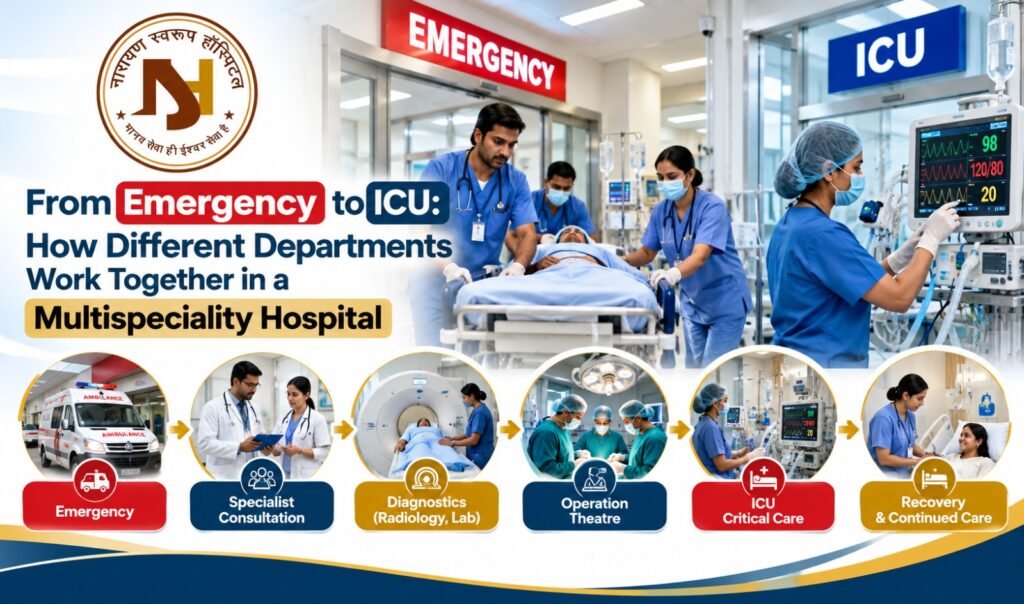

When a patient arrives with a serious injury, breathing difficulty or a sudden illness, several multispeciality hospital departments may need to work together. Understanding their roles helps patients, families and nursing students see how assessment, investigations, treatment and recovery are connected.
A multispeciality hospital is a facility which unites specialists of various medical and supporting professions. While each department performs its particular function, the process of medical assistance is based on successful cooperation between them.
What Are Multispeciality Hospital Departments?
Specialised hospital departments are distinct components in one hospital offering various types of healthcare provision. They could range from emergency medicine, intensive care, general medicine, surgery, obstetrics, paediatrics, diagnostic imaging and laboratories.
This is done for the purposes of linking the resources and skills necessary to assess the health situation of the patient, devise a course of treatment and observe the results of the treatment process. It is not the case where all patients require all the departments because it is dependent on the patient’s symptoms and medical condition.
A patient with a suspected bone fracture will have to be assessed in the emergency unit and an X-ray taken before being referred to an orthopedic specialist.
How Does the Emergency Department Work?
The emergency department is typically the initial place where people seek urgent medical treatment. Its main function is to diagnose any dangerous illness, provide urgent treatment, and plan the future actions.
Functions of the emergency department staff
- Primary assessment: Staff will examine the symptoms, health history of a patient and vital signs, including pulse, blood pressure, breathing, and oxygen saturation level.
- Triage: Patients are prioritized according to the seriousness of their health condition, rather than the arrival order.
- Stabilization: The team can provide oxygen, medications, wound management and other urgent treatment measures depending on the patient.
- Diagnosis organization: Tests and consultations with specialists may be needed in order to provide further treatment.
- Transfer or discharge decision: Patient can either be hospitalized, transferred to another department, or discharged with the right recommendations.
It is important for the emergency department to coordinate its work with other departments, especially when surgical intervention or consultation of a specialist is needed.
What Happens When a Patient Needs ICU Care?
The ICU is an area that provides close observation and specialized attention to patients who are critically ill and need closer monitoring and treatment than what is available in a regular hospital ward.
What type of care is provided in the ICU?
Some of the conditions that may warrant a patient being in the ICU include infections, serious injuries, breathing difficulties, postoperative complications or any other critical illness.
According to the patient’s health state, care in the ICU can be:
- Vital signs need to be constantly monitored.
- Respiratory care, involving mechanical ventilation if necessary.
- Medications administered and controlled under the guidance of physicians.
- Constant monitoring of fluid balance and organ functioning.
- Doctors, nurses, and other concerned specialists will need to reassess regularly.
Physicians, critical care nurses and other healthcare personnel form the ICU team. The common objective is to keep track of the patient and treat him accordingly.
ICU and Emergency Department: How Do They Work Together?
The ICU and emergency department have different responsibilities, but they often work closely together when a patient is critically ill.
| Emergency Department | Intensive Care Unit |
| Assesses urgent medical problems | Provides close monitoring and specialised care |
| Prioritises patients through triage | Manages patients who need intensive support |
| Begins immediate stabilisation | Continues treatment and reassesses progress |
| Coordinates tests and specialist reviews | Coordinates ongoing critical care and consultations |
| Determines the next appropriate care setting | Plans treatment and transfer when intensive care is no longer required |
A typical patient care pathway
Imagine a patient presenting with breathing difficulty to the point of becoming severe. The pathway could go as follows:
- Emergency assessment: The care team evaluates the patient’s breathing, circulation, symptoms and vitals.
- Immediate treatment: Stabilization is undertaken while further investigation of the problem is carried out.
- Diagnosis: Blood tests, X-rays or other investigations may be ordered if required clinically.
- Consultation: Relevant doctor or critical care specialist may be consulted if required.
- ICU admission, if required: If the patient requires further monitoring and support of body organs, the patient is transferred once it becomes clinically necessary.
- Reassessment: The patient is monitored by the ICU team and the management of the condition is adjusted accordingly.
This pathway represents an example, but the pathway will vary from one patient to another. There are patients who recover in the emergency room without requiring any ICU admission. Other patients may require immediate surgical intervention or other specialist help.
Other Important Hospital Departments and Services
Teams from the emergency room and the ICU get assistance from other departments in form of timely information, specialized care and support. This will be depending on the hospital’s facilities.
1. Laboratory diagnostic
Lab technicians conduct tests using samples collected. Tests include blood count, blood sugar, kidney functions among other tests prescribed by the treating doctors.
2. Radiology and Imaging
Services like x-ray, ultrasonography, CT-scan among others are performed by the radiology department. These services are used by clinicians to investigate any injury, internal bleeding and other suspected ailments.
3. Operation theater and surgical services
Whenever a patient is suspected to require surgical intervention, the surgery department coordinates with the anaesthesia, nursing department and other departments involved. Emergency surgery may be required by certain types of injuries or medical conditions depending on the clinical findings.
After surgery, patients may be put in recovery rooms, general wards or in the ICU, depending on their conditions.
4. Departments of general medicine and specialists
Doctors and specialists evaluate patients’ medical condition and prescribe necessary investigations and treatment plans. They may involve specialists like cardiologists, neurologists, orthopaedic among others.
5. Pharmacy and Blood Bank Services
Pharmacy plays a vital role in managing and distributing drugs safely. When needed and available, Blood Bank Services will play their role in providing blood products following procedures.
6. Nursing Services
Nurses are responsible for patient care at the bedside, monitoring the patients, administering medicine and reporting changes to the clinical team. Nurses also ensure that patients are aware of their treatment regimen and how to proceed with the next phase of treatment.
Why Communication Between Departments Matters
It is very crucial for effective communication between the teams in case of change in the patient’s health status and multi-team treatment. Teams need to share clear, up-to-date information about the patient’s symptoms, medications, allergies, test results and ongoing treatment.
In hospitals there are systems of handovers, patients’ records, referrals and team discussions that help to ensure continuity of care. It is necessary to provide the information on the patient, patient safety protocols and responsibilities in the transfer process.
Thus, in case of transfer from emergency unit to the ICU the receiving team requires the information about the condition of the patient, treatment that was provided to him/her, investigation results and possible issues.
However, the result depends on many factors such as patient’s condition, timely provision of treatment, etc.
What Nursing Students Can Learn From Hospital Coordination
Hospital department exposure is essential for nursing students to link classroom-based theoretical knowledge to practical nursing. In hospitals, the student will be able to understand the interaction of healthcare practitioners and the difference in responsibilities in varied care environments.
Some of the things students may learn through supervision in the clinical setting include:
- Observation of the patient: Taking measurement and noting the vital signs with proper supervision.
- Documentation of the patient: Keeping proper documentation and reporting any observations.
- Prevention of infection: Proper infection control measures including hand washing.
- Communication with the patient: Talking respectfully with the patient and his or her family members, protecting their privacy.
- Coordinating of the team: Understanding how nurses interact with physicians and other health practitioners.
- Transfer of the patient: Understanding the importance of handovers when a patient moves from one department to another.
It is imperative that the students follow the training and supervision procedures of their institutions and hospitals. They should not do procedures that surpass their training levels.
The nursing students in Prayagraj and Uttar Pradesh should be exposed to the coordination of the hospital teams and gain some knowledge. This will be helpful for their future clinical practice.
Frequently Asked Questions
1. What kind of departments are commonly present in a multispeciality hospital?
Some common departments can be Emergency Medicine, ICU, General Medicine, Surgery, Radiology, Laboratory Services, Pharmacy, Nursing, Maternity and Paediatric Care.
2. What distinguishes the Emergency Department from the ICU?
Emergency Department admits patients requiring emergency treatment and stabilises their conditions. The ICU is a place for intensive monitoring and special support of critically ill patients.
3. Is every patient coming to the Emergency Department in need of ICU admission?
Not necessarily. Some patients coming to the Emergency Department can be treated there and discharged, some – transferred to another department.
4. How doctors and nurses cooperate in patient treatment?
Doctors and nurses communicate about the patient’s state via records, handovers, treatment consultations and other ways. Nurses observe the patient and inform doctors about any changes in his state. Doctors make decisions on treatment based on the current clinical situation.
5. Why is knowing the hospital structure beneficial for nursing students?
Because it gives students the knowledge of referral routes, nursing roles, patient safety, communication between professionals and other important aspects of patient care.
Conclusion
There is collaboration between different hospital departments that ensure that the patient receives continuous care from the emergency assessment up to intensive care and recovery. While the Emergency Department concentrates on the initial assessment and stabilization of the condition of the patients, ICU ensures special monitoring and support for those who are critically ill.
It is crucial for nursing students to know all these connections in order to get ready to practical training. It will help students to become familiar with the system of hospital communication and cooperation in their future healthcare career.
Medical Disclaimer: This article is designed for educational purposes only and is not intended to substitute for qualified health care advice. Hospital procedures and offered services differ. In case of medical emergencies, please call your local emergency services.
Our Recent Blogs
Explore our recent articles on surgical treatment, fertility and pregnancy care:
- General Surgery vs Laparoscopic Surgery: What Patients Should Know Before Treatment
- Infertility: Common Causes, Evaluation and When Couples Should Consult a Specialist
- High-Risk Pregnancy Care in Prayagraj: What Expecting Mothers Should Know
Planning a visit? Find us on Google Maps for our location, directions and contact details.