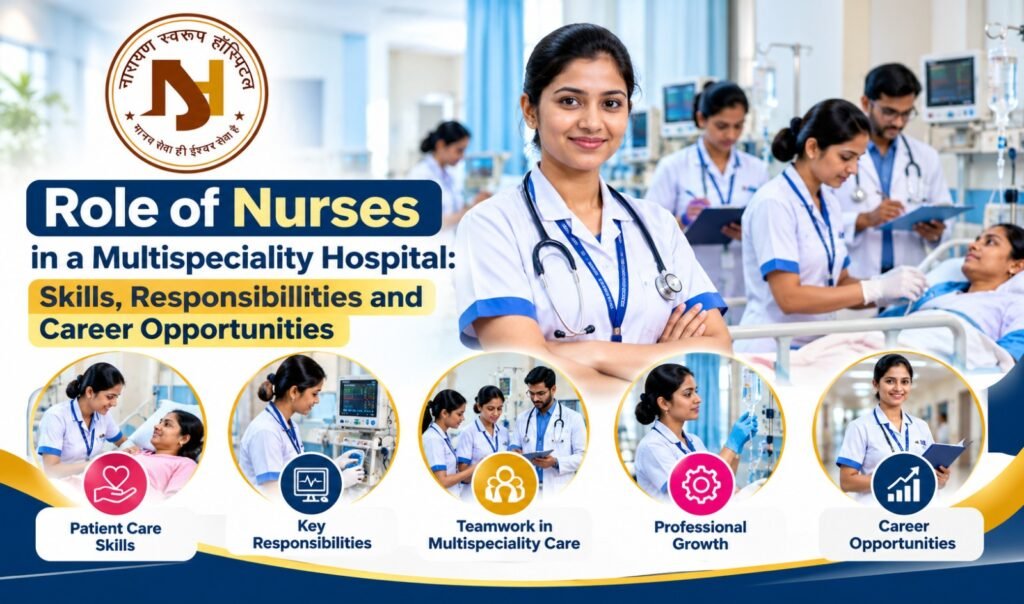

The role of nurses in a multispeciality hospital includes patient monitoring, administering prescribed medicines, preventing infections and coordinating care. Understanding these responsibilities helps nursing students see how nurses support patient safety and recovery across different departments.
Since a multispeciality hospital is formed with different surgical and medical departments in one place, nurses take care of patients in the emergency room, ICUs, general wards, maternity sections and operation theaters. The job of a nurse is far beyond just supporting a doctor. Nurses notice the changing condition of the patient, give him his/her medicines and make records.
It is helpful for nursing students from Prayagraj and elsewhere in Uttar Pradesh to know about all of this.
What Is the Role of Nurses in a Multiplicity Hospital?
The tasks of nurses in a multispeciality hospital include caring for the patients directly, monitoring the health condition of the patient, assisting with the therapy of the patient, preventing any infection and coordinating with other healthcare professionals.
The specific tasks of the nurse are determined by their qualification, training, department and hospital policy.
Key Nursing Responsibilities in a Hospital
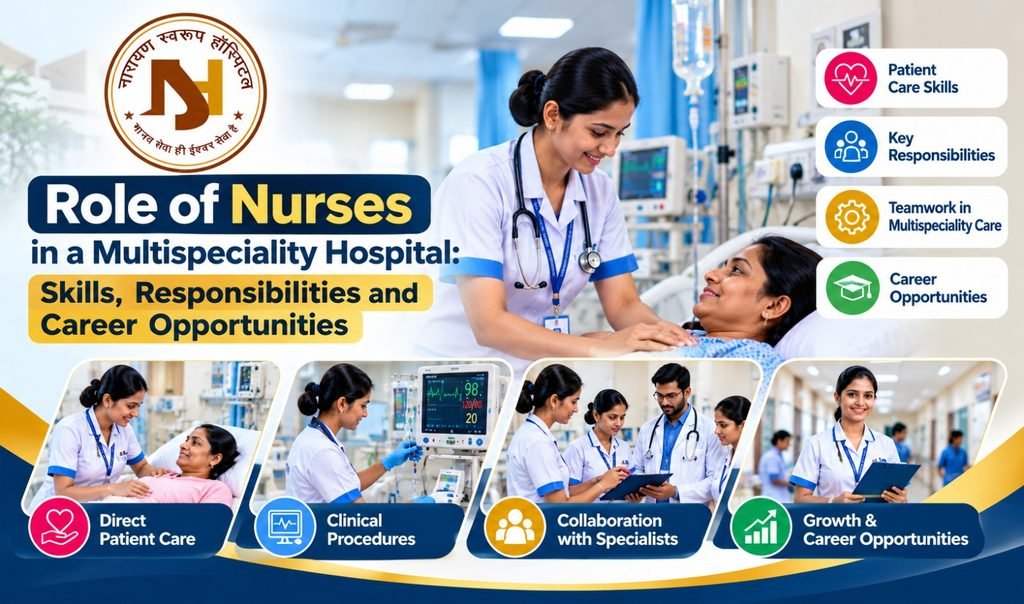
The tasks done by nurses in their shifts include the following, and all these need detail and professional judgment besides good communication.
1. Health monitoring of Patients
In case it is needed, nurses do patient health checks such as temperature, respiratory rate, blood pressure, oxygen saturation, and pulse. They monitor the condition and report any changes to the required healthcare provider.
For instance, the condition of the patient needs checking in case there are changes in breathing and level of consciousness. Proper communication will enable the clinical team make proper response.
2. Administration of Medicines
Nurses give medicines following proper prescription, professional scope, and hospital policies. They confirm the needed information and allergies. Besides, they follow the safety measures and document the administration process.
When they have concerns related to medicines, they consult the responsible clinician without making unauthorized changes to the medicines prescribed.
3. Assistance to Doctors and other Healthcare Providers
Nurses collaborate with doctors and other healthcare providers during patient diagnosis and treatment. This depends on their expertise and the required tasks.
4. Documentation of Patient Information
Documentation is an essential aspect of nursing practice. The documentation could be on the vital signs, medications given, patient observations, nursing interventions, and patient conditions.
Effective documentation enables continuity in patient care, particularly when patients are transferred from one department to another or when the nursing staff change shifts.
5. Preventing Infections
The nurses assist in minimizing infection threats through adherence to hand hygiene protocols, wearing appropriate protective clothing, maintaining sterile conditions where necessary, and observing the infection prevention guidelines of the hospital.
6. Educating and Supporting Patients
During hospitalization, the patient could be nervous or disoriented. The nurses provide information on how the care should be done and respond to inquiries within the scope of their profession.
Upon discharge, they could assist the patients in understanding their medication regimen, appointments, wound care, and symptoms of concern requiring medical assistance.
Nursing Roles Across Different Hospital Departments
Multiplicity hospitals provide different clinical environments, and nursing duties vary accordingly.
| Department | Common nursing responsibilities |
| Emergency department | Supporting rapid assessment, monitoring patients and assisting with urgent care |
| Intensive care unit (ICU) | Close observation, specialised monitoring and supporting critical care |
| General ward | Daily patient care, prescribed medicines, documentation and recovery support |
| Operation theatre | Preparing equipment, maintaining sterile practices and assisting within assigned duties |
| Maternity department | Supporting maternal care, monitoring and patient education according to training |
| Paediatric department | Providing age-appropriate care and communicating with parents or guardians |
Nurses must follow the specific training, supervision and safety requirements of their department. Not every nurse is qualified or authorised to perform every clinical task.
Essential Skills Required for Nurses
Good nursing practice is an amalgamation of theoretical knowledge and practical skills. All three elements can be nurtured in students through their learning period and clinical experience.
Clinical and Practical Skills
Knowledge about basic anatomy and physiology, pharmacology, infection control, monitoring of vital signs, medication administration and patient assessment is required of all nurses. Additional competences such as wound management, collecting specimens and using monitoring equipment may be necessary depending on the nurse’s job.
Developing practical competence requires proper training, practice and evaluation.
Communication and Cooperation
Nurses spend time talking with their patients, family members of the latter, physicians and other healthcare professionals. They must deliver information clearly, listen attentively and report any observations without undue delay.
Effective cooperation becomes especially crucial when caring for a patient in case when the treatment plan requires the efforts of more than one department.
Observation and Attention to Details
Any small change in a patient’s complaints, behaviour or vital signs can have clinical significance and require proper observation and documentation.
Professional Ethics and Empathy
Patience, respect, discretion and dignity are necessary in the nursing profession, as nurses might work with people in distress, fear and pain.
Time Management and Flexibility
Priorities in hospitals can shift rapidly and nurses have to organize their activities, follow patient care plans, fill out forms and take care of their patients at the same time.
Nursing Career Opportunities in Multiplicity Hospitals
Career prospects in nursing vary according to education, registration, experience and other trainings.
Career prospects may include:
- Staff nurse – Provision of regular and specialized care to patients in assigned department.
- Emergency nurse – Assistance of patients requiring urgent treatment and evaluation.
- Critical care nurse – Provision of care to critically ill patients with training and experience required.
- Operation theatre nurse – Provision of support to surgical team in operating room with correct practices.
- Maternity nurse – Assistance of women with maternal care and patient education in their role of nursing.
- Pediatric nurse – Provision of care to infants, children and adolescents in respective department.
- Nurse educator – Training and supervision of nursing students with relevant qualifications.
- Nursing administrator/supervisor – Coordination of nursing teams and staff with relevant experience.
Qualification and eligibility criteria vary for different careers. Nursing students must verify the nursing education, registration and recruitment criteria for nursing specialisations.
How Nursing Students Can Prepare for Hospital Work
Nursing education sets the stage for safe and efficient practice of nursing. Students can get prepared for future roles by ensuring adequate theoretical learning and clinical experiences.
Some useful tips are:
- Improve subject knowledge: Understand the subjects like Anatomy, Physiology, Pharmacology, Medical-surgical nursing, Infection Prevention.
- Develop practical skills: Learn the procedure through authorized demonstration, simulations and clinical practice.
- Enhance communication skills: Practice good patient communication, report writing and clinical handovers.
- Document: Learn about the documentation of comprehensive, objective and confidential patient notes.
- Safety practices: Pay attention to medication safety, patient identification, and infection control.
- Feedback: Get help from the instructors and clinical supervisors to learn your weakness.
Students looking for information regarding nursing education at Prayagraj may want to consider Narayan Swaroop Nursing College.
Frequently Asked Questions
1. What is the major function of a nurse at a multispeciality hospital?
The major function includes provision of safe care of the patients, monitoring their health status, administering the medication prescribed and record maintenance.
2. What are the skills needed by hospital nurses?
Patient assessment, medication safety, communication, teamwork, infection control, record keeping and compassion are among those skills.
3. Can nurses work in ICU or operation theatre?
Yes. If the nurse qualifies, registers and meets other conditions as per the hospital rules, she can work there.
4. What are the career prospects in nursing after graduation?
Based on qualification and recruiting rules of the hospital, the nurse can begin as a staff nurse and then specialize in various branches of nursing.
5. Why is clinical training important for nursing students?
It is important because they will be able to link their theoretical knowledge with practical skills, learn patient care process, communicate and follow safety rules in hospitals.
Conclusion
The role of nurses in a multispeciality hospital extends across direct patient care, clinical observation, medication safety, infection prevention and communication between healthcare teams.
Nurses play a part in enhancing patient safety and continuity of treatment while working together with doctors and other medical practitioners.
For any person who intends to become a nurse, it is important to develop competency, empathy, observational abilities, and professionalism.
With proper nursing training and clinical experience, one can explore different nursing careers available in Prayagraj.
Our Recent Blogs
Explore our recent articles on surgical treatment, fertility and pregnancy care:
- General Surgery vs Laparoscopic Surgery: What Patients Should Know Before Treatment
- Infertility: Common Causes, Evaluation and When Couples Should Consult a Specialist
- High-Risk Pregnancy Care in Prayagraj: What Expecting Mothers Should Know
Planning a visit? Find us on Google Maps for our location, directions and contact details.