This is an occupation that requires both sound knowledge and adequate skill. The experience of nursing students in the hospital environment enables them to learn patient care, work as part of a team, communicate, and adhere to hospital safety measures.
The reading of the textbook is important, but there is more to nursing students than this. They should know how healthcare teams do patient assessment, keep records and follow infection control measures. This will enable the student to be ready for future roles when they complete their studies.
For those seeking nursing education in Prayagraj, it would be important to understand the importance of hospital training.
What Is Hospital Training for Nursing Students?
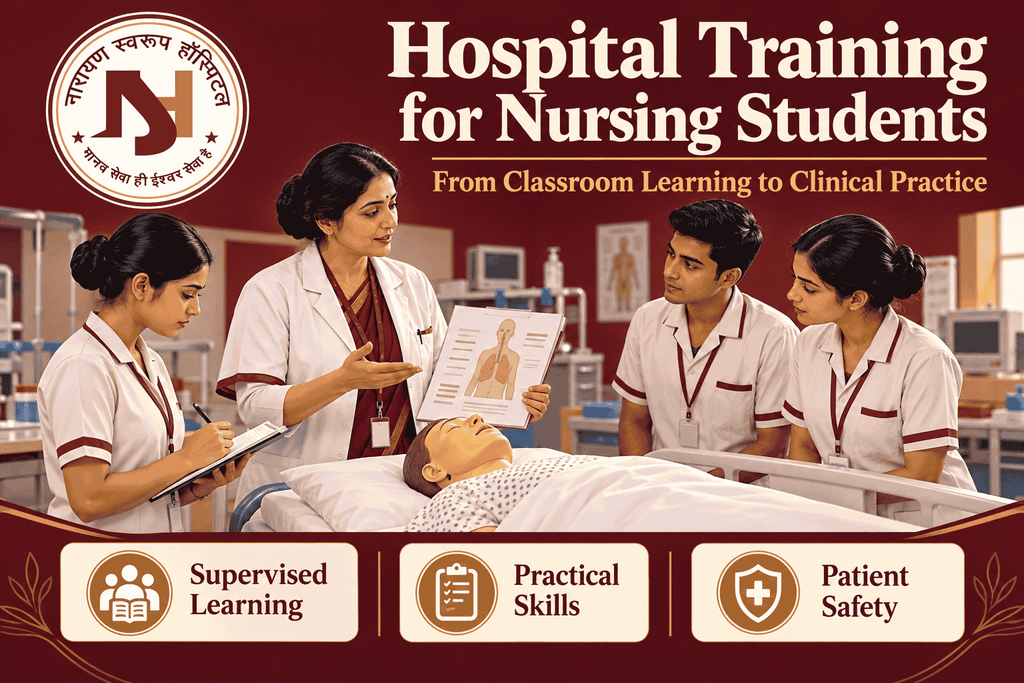
Hospital training is a well-structured learning activity where nursing students learn and practice the proper clinical skills in the presence of experienced teachers and approved health care professionals. It enables them to put their nursing theories into application while learning about professional ethics and safety precautions.
This will be achieved through being exposed to various departments within the hospitals such as general wards, outpatients’ department, emergencies, maternity wards, pediatric care, among others.
It is not a substitute for the qualified personnel but rather students acquire skills gradually depending on their course needs and competence levels.
Why Clinical Exposure Matters in Nursing Education
Clinical exposure for nursing students is an avenue whereby the students get to know how the health care sector functions away from classrooms. The students are able to see patient care procedures, departmental coordination and the application of nursing concepts in various circumstances.
1. Relating Theory to Practice
In classrooms, students are taught various topics, including anatomy, physiology, pharmacology and medical-surgical nursing. Hospital exposure allows the students to relate all this information to patient assessment, treatment prescription and patient care.
For instance, the students might be taught the topic of vital signs in classrooms but, through clinical exposure, they will see how nurses take, record and report the patient’s vital signs, which include the body temperature, pulse, blood pressure and breathing rate.
2. Development of Patient Care Skills
Clinical exposure may include the participation in important nursing functions by the students through clinical supervision. Some of these nursing functions are:
- Measurement of vital signs.
- Observance of hand washing and prevention of infections.
- Accurate patient documentation.
- Respectful communication with the patient.
- Training in patient identification and safety checks.
- Observation of nursing assessment and procedures.
The students must undertake any clinical procedure only if authorized and trained.
3. Understanding Hospital Workflows
The hospital requires the coordination between nurses, doctors, lab professionals, pharmacists and other health practitioners. Through clinical exposure, students will learn about information sharing, patient referrals and the importance of accurate handovers.
This is especially important where patients go from one department to another or require the services of more than one specialist.
4. Gaining Confidence and Professionalism
Interaction with patients and observation of healthcare teams can help students become confident in the professional way of doing things. Students are taught the importance of respecting patient privacy, being confidential and behaving in an appropriate manner.
Confidence must come with competence. Students must be aware of their limitations, ask questions where they don’t know and seek guidance rather than perform unfamiliar procedures.
What Can Students Learn in Different Hospital Departments?
An institute for nurses that provides hospital training will ensure that students have access to various clinical settings based on its curriculum and clinical facilities.
| Clinical area | Potential learning opportunities |
| General wards | Daily patient care, vital-sign monitoring and documentation |
| Emergency department | Understanding triage, urgent assessment and team coordination |
| Intensive care unit | Observing close monitoring and specialised care for critically ill patients |
| Maternity services | Learning about maternal care and patient education |
| Paediatric services | Understanding age-appropriate care and communication with families |
| Operation theatre | Observing sterile practices, surgical preparation and team responsibilities |
| Outpatient department | Learning patient flow, consultation processes and health education |
Not every student will undertake the same activities in every department. Access, supervision and learning objectives depend on the institution’s programme and clinical arrangements.
How Practical Nursing Education Supports Job Readiness
Practical nursing education helps trainees to be professional and prudent when handling their clinical duties.
Hospital training may be used in helping trainees develop some of the following skills:
Documentation Skills
Records are an essential part of any nursing practice. This is because they ensure that patients’ treatment is properly documented. Practical training teaches nursing trainees on the importance of accuracy and timeliness when documenting patient conditions.
Application of Patient-Safety Principles
Patient identification, medication safety, infection control and concern escalations are some aspects that make up nursing practices. Clinical training helps trainees to understand the application of such principles in practice.
Communication Skills
Nurses have to be able to communicate with patients, families and fellow nurses. Practical nursing helps trainees to learn how to listen, report findings to the relevant health care professionals and use proper language when explaining things to patients.
Professional Obligations
Nursing students will also get to know through clinical training that nursing requires them to be accountable. They have to adhere to the policies of their institution and perform only within their scope of practice.
Hospitals may not necessarily provide employment, but it helps trainees prepare for nursing roles.
What Should Students Check Before Choosing a Nursing College?
The students who want to enrol in any nursing course at Prayagraj must go into detail about the course names and their promotional details. Questions regarding clinical placements must be asked by the prospective students before taking up a particular course.
Before enrolment, it is necessary to check:
- Recognition and approval: Make sure that the course fulfills all the relevant requirements.
- Clinical training placements: Where do the students make their clinical postings? Are these arrangements officially made?
- Supervision: Who supervises the students while in clinical placement and how are the skills of the students tested there?
- Departmental placements: What are the clinical departments in the course? What kind of postings schedule does the institution follow?
- Practical skills facilities: What are the skills laboratories, demonstrations, and other facilities available to the students?
- Instructors’ assistance: How do the instructors help the students improve in their skills?
This list of questions will help you understand the current courses, clinical training placements, and facilities of Narayan Swaroop Hospital and Nursing College.
Frequently Asked Questions
1. Why is hospital training essential for nursing students?
It allows the student to link theory and practice in the hospital, understand how the hospital works, develop communication skills, and learn patient safety techniques.
2. What is clinical exposure for nursing training?
Clinical exposure is the ability to observe and engage in the right kind of healthcare work as part of a nursing programme under supervision.
3. Will hospital training boost the confidence of a nursing student?
It might help in doing so, although the confidence level must come after competence and safe practice.
4. What should a student look out for in a nursing school with hospital training?
A student should consider regulation recognition, clinical placements, supervision, facilities, course requirements, and learning opportunities.
5. Will hospital training secure nursing employment?
No. It will certainly help in preparing for the professional role, but getting the job depends on many other factors.
Conclusion
Hospital training for nursing students helps develop practical skills and an understanding of patient care. Through supervised clinical exposure, students learn the importance of teamwork, safety, accurate documentation and professional responsibility.
It is, therefore, important for nursing aspirants in Prayagraj and Uttar Pradesh to select a course that suits them well, taking into consideration academic standards and arrangements for clinical exposure.
Our Recent Blogs
Explore our recent articles on laparoscopic surgery and women’s health:
- Laparoscopic Gynecological Surgery: Procedures, Benefits and Recovery Explained
- Common Gynecological Problems Women Should Never Ignore
- What Is Laparoscopic Surgery? Benefits, Procedures and Recovery Explained
Planning a visit? Find Narayan Swaroop Hospital on Google Maps for our location, directions and contact details.